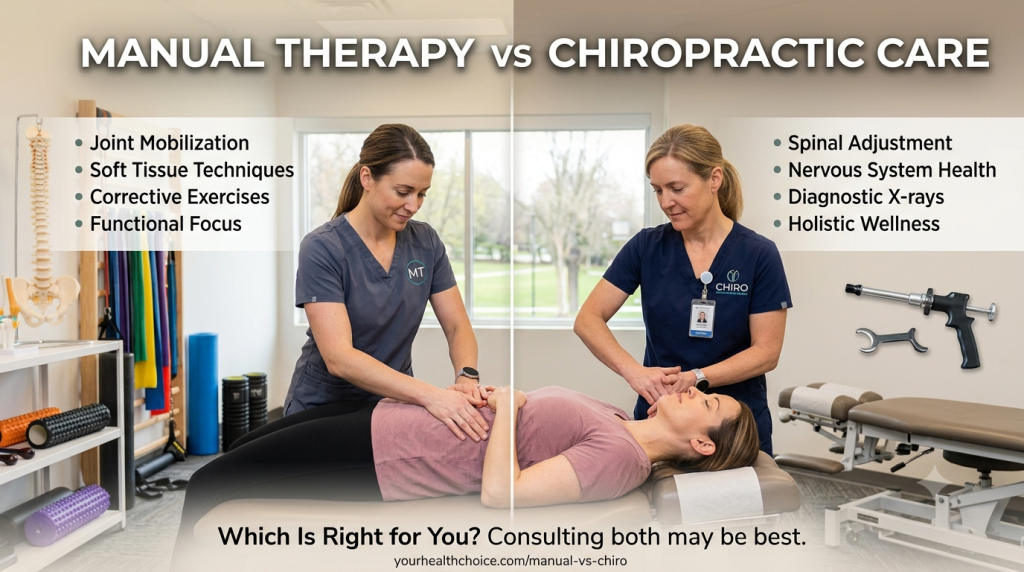
Manual Therapy vs Chiropractic Care: What’s the Difference?
If you are experiencing back pain, neck pain, joint stiffness or movement problems, you
may wonder whether manual therapy or chiropractic care is the better option.
The answer is not as simple as choosing one profession over another.
Both physiotherapists and chiropractors may use hands-on techniques, including forms
of joint mobilization or manipulation. However, their training, scope of practice,
clinical approach and overall treatment plans can differ depending on the
practitioner and healthcare system.
Manual therapy is also not a profession by itself. It is a group of hands-on techniques
that can be used by appropriately trained healthcare professionals as part of a broader
treatment plan.
The most important question is therefore not simply:
“Which treatment is better?”
Instead, ask:
“Which approach is appropriate for my condition, goals and overall health?”
For people with musculoskeletal problems, an assessment can help determine whether
hands-on treatment is appropriate and whether it should be combined with exercise,
education, self-management or another form of care.
Quick Answer: Manual Therapy vs Chiropractic Care
Manual therapy generally refers to hands-on techniques used to assess or treat
movement-related problems. These can include joint mobilization, soft-tissue
techniques and, in some clinical settings, manipulation.
Chiropractic care is a healthcare profession that commonly focuses on
musculoskeletal conditions, particularly problems involving the spine and joints.
Chiropractors may use spinal manipulation, mobilization, exercise, education and other
approaches depending on their training and clinical practice.
There can be overlap between the two.
For example, both a physiotherapist and chiropractor may use:
• Joint mobilization
• Spinal manipulation
• Soft-tissue techniques
• Exercise
• Movement advice
• Education
The key difference is that manual therapy describes a treatment approach, while
chiropractic is a healthcare profession.
What Is Manual Therapy?
Manual therapy refers to hands-on techniques used to influence movement, pain or
function.
Depending on the clinician and the person’s condition, manual therapy may include:
• Joint mobilization
• Soft-tissue techniques
• Massage-based techniques
• Passive movement
• Spinal mobilization
• Manipulation when clinically appropriate
Manual therapy is often used alongside active rehabilitation rather than as the only
treatment.
For example, someone with back pain might receive a combination of:
Assessment → Education → Manual therapy when appropriate → Exercise →
Progressive activity → Self-management
The goal is not simply to provide temporary relief but to help the person return to
meaningful activities.
The Dr. Tapas Mitra clinic describes manual therapy in this way: hands-on techniques
are integrated with movement, education and exercise when appropriate, following an
individualized assessment.
What Is Chiropractic Care?
Chiropractic is a healthcare profession focused primarily on the diagnosis and
management of musculoskeletal conditions, particularly those involving the spine and
joints.
Depending on the practitioner, chiropractic care may involve:
• Spinal manipulation
• Joint mobilization
• Exercise
• Education
• Advice about activity
• Other conservative treatments
Chiropractic treatment is not limited to one technique, and the exact approach can vary
between practitioners.
For someone considering chiropractic care, it is important to understand what
assessment will involve, what treatment is being recommended and why it is
considered appropriate for the individual’s condition.
Is Manual Therapy the Same as Chiropractic?
No.
Manual therapy and chiropractic care overlap, but they are not the same thing.
Manual therapy describes what a clinician may do—hands-on techniques to address
pain, mobility or function.
Chiropractic describes a healthcare profession whose practitioners may use manual
techniques as part of their care.
A simple example:
Manual therapy is like describing a treatment method, while chiropractic describes a
professional healthcare discipline.
A physiotherapist can use manual therapy without being a chiropractor.
Similarly, a chiropractor may use manual therapy as part of chiropractic care.
Is Manual Therapy Better Than Chiropractic?
There is no universal answer.
For some people, manual therapy provided by a physiotherapist may fit well with an
exercise-based rehabilitation plan.
For others, chiropractic care may be an appropriate option.
The choice should depend on:
• Your diagnosis or working clinical assessment
• Your symptoms
• Your medical history
• Your goals
• Your functional limitations
• Your preferences
• The clinician’s trainin
• Whether the recommended treatment is appropriate for your condition
For chronic primary low-back pain, WHO guidance includes spinal manipulative
therapy as a possible option, but recommends it conditionally and notes the evidence
certainty is very low. WHO also emphasizes tailored care and combinations of
appropriate interventions rather than relying on a single intervention.
Which Is Better for Back Pain: Manual Therapy or Chiropractic?
Both approaches may be used for certain types of musculoskeletal back pain.
However, hands-on treatment alone is not necessarily the most useful long-term
strategy.
For many people with back pain, a broader plan may include:
• Education
• Staying appropriately active
• Exercise
• Strengthening
• Movement training
• Activity modification
• Manual therapy when appropriate
• Self-management
The American Physical Therapy Association’s low-back-pain clinical practice guideline
includes manual therapy among interventions considered in physical therapy
management, alongside active approaches.
WHO similarly emphasizes a tailored approach and recognizes that multiple
interventions may be needed for chronic primary low-back pain.
What Are the Benefits of Manual Therapy?
When appropriately selected, manual therapy may help some people with:
• Short-term pain relief
• Joint mobility
• Movement-related discomfort
• Muscle or soft-tissue symptoms
• Confidence with movement
One potential advantage of integrating manual therapy with exercise is that temporary
symptom relief may make it easier for a person to participate in active rehabilitation.
However, results vary from person to person.
Manual therapy should not be presented as a guaranteed cure or as something that
permanently “realigns” the spine.
What Are the Benefits of Chiropractic Care?
Depending on the individual practitioner and condition, chiropractic care may provide:
• Musculoskeletal assessment
• Spinal or joint manipulation
• Joint mobilization
• Exercise advice
• Education
• Conservative management of certain musculoskeletal problems
Some people may experience short-term improvements in pain or function after spinal
manipulation.
However, chiropractic treatment is not appropriate for every condition.
A proper assessment is important before any spinal manipulation or other hands-on
intervention.
Can Manual Therapy and Chiropractic Care Be Used Together?
The techniques can overlap, but receiving multiple hands-on treatments is not
automatically better.
If you are already receiving care from one healthcare professional, it is useful to
understand:
• What treatment is being provided
• Why it is being recommended
• What the expected benefit is
• What active rehabilitation you should be doing
• How progress will be measured
A good treatment plan should have a clear purpose rather than simply adding more
hands-on treatment.
Manual Therapy vs Chiropractic for Neck Pain
Neck pain can have many causes.
Manual therapy may sometimes be combined with:
• Neck mobility exercises
• Strengthening
• Postural or movement education
• Activity modification
• Progressive rehabilitation
Chiropractors may also use manual techniques for some neck-related musculoskeletal
problems.
However, neck manipulation is not appropriate for everyone.
A clinician should screen for relevant medical and neurological warning signs before
deciding whether manipulation or other manual techniques are appropriate.
If you have sudden severe neck pain, neurological symptoms, dizziness, fainting, visual
changes, severe headache or other concerning symptoms, seek appropriate medical
assessment rather than assuming that manual therapy or chiropractic care is suitable.
Manual Therapy vs Chiropractic for Lower Back Pain
For lower back pain, treatment should depend on the type and presentation of the
problem.
For many people with non-specific low-back pain, appropriate management may
include:
• Remaining active
• Exercise
• Education
• Progressive strengthening
• Manual therapy when appropriate
• Self-management
WHO identifies physical therapies and exercise-related approaches as part of nonsurgical management for low-back pain, while emphasizing individualized care
This means the best treatment is often not simply “manual therapy versus
chiropractic.”
It may instead be:
Assessment + appropriate hands-on care + exercise + education + gradual return to
activity
Is Manual Therapy Safe?
Manual therapy is generally considered safe when appropriately selected and
performed by a suitably trained professional, but no treatment is completely risk-free.
Possible temporary effects can include:
• Mild soreness
• Temporary increase in symptoms
• Stiffness
• Fatigue
More forceful manipulation techniques require appropriate screening and clinical
judgment.
A practitioner should consider your:
• Medical history
• Current symptoms
• Medications
• Neurological symptoms
• Other health conditions
• Relevant warning signs
If you have concerns about a treatment, ask the clinician to explain the expected
benefits, risks and alternatives.
Is Chiropractic Care Safe?
Chiropractic treatment can be appropriate for some people, but the safety of a specific
technique depends on the individual and the treatment being performed.
Why Choose Physiotherapy With Manual Therapy?
If you are considering manual therapy for back, neck, shoulder or joint pain,
physiotherapy can provide an advantage for people who want hands-on treatment
integrated into a broader rehabilitation programme.
Instead of focusing only on the painful area, a physiotherapist may assess:
• Movement
• Strength
• Mobility
• Function
• Activity demands
• Work requirements
• Exercise goals
• Recovery expectations
Manual therapy can then be used when clinically appropriate, alongside exercise and
self-management.
This is the approach described by Dr. Tapas Mitra Physiotherapy & Manual Therapy
Clinic.
Manual Therapy in Bhubaneswar
If you are searching for manual therapy in Bhubaneswar, Dr. Tapas Mitra Physiotherapy
& Manual Therapy Clinic provides an assessment-led approach in Saheed Nagar.
The clinic states that manual therapy is considered after assessment and may be
combined with:
• Exercise
• Progressive activity
• Education
• Self-management
• Movement analysis
• Appropriate hands-on care
• Referral when necessary
The clinic is located at:
Dr. Tapas Mitra Physiotherapy & Manual Therapy Clinic
Plot No A/195, Maharishi College Road
Opposite ESI Dispensary, Near Mocha House
Saheed Nagar, Bhubaneswar, Odisha – 751007
Looking for Manual Therapy in Bhubaneswar?
If pain or stiffness is affecting your daily activities, exercise or work, an assessment can
help determine whether manual therapy is appropriate for your condition.