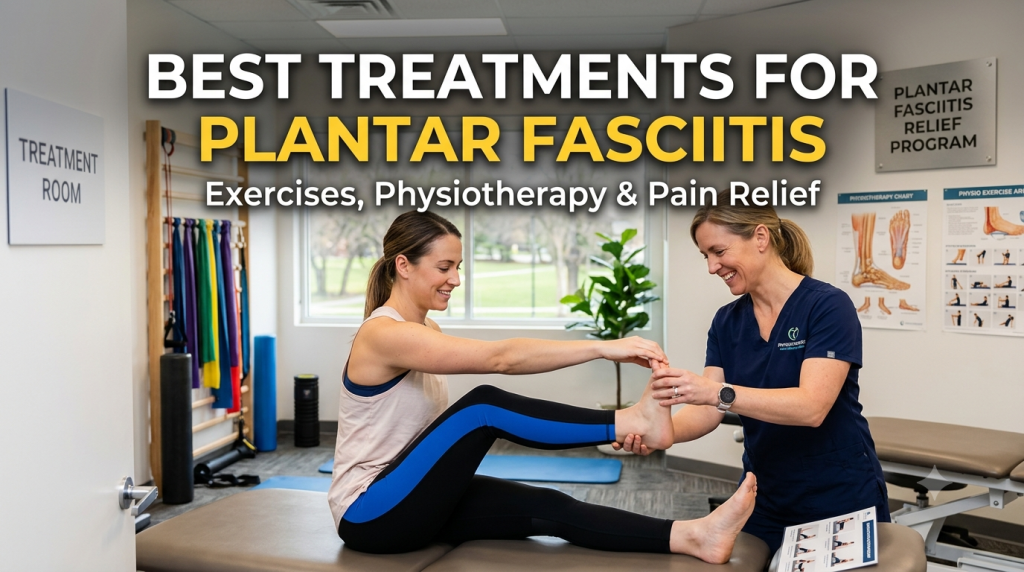
What Is the Best Treatment for Plantar Fasciitis?
The best treatment for plantar fasciitis depends on your symptoms, activity level, foot
mechanics and how long you have had the pain.
For many people, conservative treatment is the first approach. This can include
activity modification, appropriate footwear, stretching, strengthening exercises and
physiotherapy. Insoles or heel supports may also help some people manage symptoms.
Plantar fasciitis commonly causes pain around the bottom of the heel or arch. A classic
symptom is heel pain during the first few steps after waking up or after sitting or
resting for a while. The pain may improve as you move but return after prolonged
walking, standing or running.
There is no single treatment that is automatically “best” for everyone. A proper
assessment can help determine which combination of treatments is appropriate for
you.
What Is Plantar Fasciitis?
The plantar fascia is a strong band of connective tissue running along the bottom of your
foot. It helps support the arch and contributes to the way your foot absorbs and
transfers forces during walking and other activities.
Plantar fasciitis refers to pain associated with this area, usually around the heel and
sometimes extending toward the arch.
The condition can develop when the tissues around the plantar fascia are exposed to
loads that exceed what they can comfortably tolerate.
Common factors associated with plantar fasciitis include:
• A sudden increase in walking or running
• Prolonged standing
• Exercising on hard surfaces
• Tight calf muscles
• Changes in physical activity
• Poorly cushioned or unsupportive footwear
• Higher body weight
• Foot structure and individual biomechanics
However, having one of these factors does not automatically mean it is the cause of
your pain.
8 Best Treatments for Plantar Fasciitis
1. Plantar Fasciitis Stretching Exercises
Stretching is commonly included in conservative treatment for plantar fasciitis.
A physiotherapist may recommend exercises targeting the:
• Plantar fascia
• Calf muscles
• Achilles tendon
• Ankle
Regular, appropriately dosed stretching may help improve mobility and reduce
symptoms.
One commonly used approach is a gentle calf stretch:
1. Stand facing a wall.
2. Place the affected foot behind you.
3. Keep the heel on the floor.
4. Slowly bend the front knee.
5. Keep the back leg comfortably extended.
6. Hold the stretch without forcing it.
7. Repeat according to your physiotherapist’s instructions.
Do not force a painful stretch. The appropriate exercise, intensity and repetitions
depend on your symptoms and physical condition.
NHS guidance also recommends regular gentle stretching for plantar fasciitis.
2. Strengthening Exercises
Stretching is only one part of rehabilitation.
A physiotherapist may also introduce progressive strengthening exercises for the:
• Calf
• Foot and ankle
• Lower leg
• Trunk and lower limb
Strengthening can help improve your ability to tolerate everyday activities and exercise.
Examples may include:
• Calf raises
• Controlled heel raises
• Foot intrinsic muscle exercises
• Progressive resistance exercises
• Functional balance exercises
The exact exercise programme should be based on your symptoms and goals rather
than simply copying a generic online routine.
3. Physiotherapy for Plantar Fasciitis
Physiotherapy can be an important treatment option for persistent or activitylimiting plantar fasciitis.
A physiotherapist can assess:
• Your pain pattern
• Walking and standing tolerance
• Ankle mobility
• Calf flexibility
• Foot and lower-limb strength
• Exercise habits
• Footwear
• Recent changes in activity
• Functional limitations
The treatment plan may include:
• Exercise therapy
• Stretching
• Strengthening
• Activity modification
• Education
• Movement retraining
• Manual therapy when clinically appropriate
• Advice regarding footwear or other supportive strategies
The aim is not simply to temporarily reduce heel pain. Rehabilitation should also help
you gradually return to normal activities.
4. Supportive Footwear
Your footwear can influence how much load your heel and plantar fascia experience
during daily activities.
If your feet hurt, consider footwear that provides:
• Comfortable cushioning
• Appropriate support
• A secure fit
• Enough room for your toes
• A sole that feels comfortable during walking
Avoid footwear that consistently aggravates your symptoms.
NHS guidance recommends comfortable footwear with cushioning and support and
advises avoiding prolonged barefoot walking on hard surfaces when managing plantar
fasciitis.
5. Insoles and Heel Supports
Some people find insoles, heel cups or arch supports helpful for reducing discomfort
during walking and standing.
However, there is no single insole that works for everyone.
A physiotherapist or podiatrist may help determine whether additional foot support is
appropriate based on your symptoms and activity requirements.
Insoles should generally be considered as part of a broader management plan rather
than as the only treatment.
6. Activity Modification
Completely stopping all activity is not always necessary.
Instead, you may need to temporarily modify activities that significantly increase your
pain.
For example, if running suddenly increased your heel pain, you may temporarily:
• Reduce running distance
• Reduce running frequency
• Avoid high-impact sessions
• Choose lower-impact activities
• Gradually rebuild your training load
The goal is to reduce excessive irritation while maintaining an appropriate level of
activity.
Swimming or other activities that put less pressure on the feet may be suitable for some
people.
7. Ice and Short-Term Pain Relief
Some people find cold therapy useful for temporary pain relief.
An ice pack wrapped in a towel can be applied to the painful area for a short period.
Do not place ice directly against the skin.
Medication such as paracetamol or ibuprofen may also be recommended in some
situations, but medicines are not appropriate for everyone. Speak with a doctor or
pharmacist if you are unsure whether a particular medicine is safe for you.
Pain relief should support your recovery rather than replace appropriate rehabilitation.
8. Other Treatments for Persistent Plantar Fasciitis
If plantar fasciitis continues despite an appropriate period of conservative
management, a healthcare professional may discuss additional options.
Depending on the individual case, these can include:
• Taping
• Night splints
• Orthoses
• Shockwave therapy
• Injection-based treatments
• Specialist referral
These treatments are not automatically necessary for everyone.
For example, NHS guidance notes that persistent cases may be managed by
physiotherapy or podiatry, while other treatments such as shockwave therapy or
injections may be considered in selected cases. Surgery is less commonly required.
What Is the Fastest Way to Get Rid of Plantar Fasciitis?
There is no guaranteed quick fix for plantar fasciitis.
Many people improve with conservative treatment, but recovery can take time. Some
NHS guidance notes that plantar fasciitis can take several months to settle and, in
some cases, up to a year.
Trying to completely eliminate pain immediately may lead to repeatedly overloading the
foot.
A better approach is usually to:
1. Identify activities that aggravate your symptoms.
2. Temporarily modify excessive loading.
3. Use comfortable and supportive footwear.
4. Start an appropriate exercise programme.
5. Gradually build strength and activity tolerance.
6. Monitor your response.
7. Seek professional assessment if symptoms persist or worsen.
How Can Physiotherapy Help Plantar Fasciitis?
Physiotherapy can help you understand why your heel pain is happening and what
you can do about it.
Rather than treating everyone with the same exercise, an assessment can identify
individual factors that may be contributing to your symptoms.
Your physiotherapist may assess:
Foot and ankle movement
Limited ankle movement or calf flexibility may influence how your foot handles load.
Muscle strength
Your calf, foot and lower-limb strength can be assessed to determine whether
strengthening should be part of your rehabilitation.
Activity level
A sudden increase in walking, running or standing can increase the load placed on the
foot.
Footwear
Your everyday shoes and exercise footwear may be discussed as part of your overall
management.
Functional goals
Your treatment should reflect what you actually want to return to—whether that is
walking comfortably, exercising, working on your feet or playing sport.
When Should You See a Physiotherapist for Plantar Fasciitis?
Consider professional assessment if:
• Heel pain is affecting your normal activities.
• Pain keeps returning.
• You cannot exercise comfortably.
• Walking or standing has become difficult.
• Symptoms continue despite self-management.
• You are unsure whether the pain is actually plantar fasciitis.
• You want a structured return-to-exercise programme.
If your pain is severe, worsening, associated with numbness or follows an injury, you
should seek appropriate medical assessment rather than assuming it is plantar
fasciitis. NHS guidance recommends professional evaluation when foot pain is severe,
worsening, recurrent, or associated with tingling or loss of sensation.
Plantar Fasciitis Treatment in Bhubaneswar
If you are looking for plantar fasciitis physiotherapy in Bhubaneswar, an
individualized assessment can help determine the most appropriate treatment
approach.
At Dr. Tapas Mitra Physiotherapy & Manual Therapy Clinic, physiotherapy can be
positioned around assessment, exercise-based rehabilitation, movement management
and individualized treatment rather than promising a single “miracle” treatment.
For someone experiencing persistent heel pain, the assessment can help determine:
• What activities aggravate the symptoms
• Whether ankle or calf mobility is limited
• Whether strengthening is appropriate
• How activity should be modified
• Whether footwear or support may be useful
• Whether further medical evaluation is necessary
Why Choose an Assessment-Led Approach?
Plantar heel pain can have different causes. Therefore, simply treating the painful spot
may not address the factors contributing to your symptoms.
An individualized physiotherapy programme can be adjusted according to your
response and functional goals.
Looking for plantar fasciitis treatment in Bhubaneswar?
Book an assessment with Dr. Tapas Mitra Physiotherapy & Manual Therapy Clinic,
Saheed Nagar, Bhubaneswar, to discuss your heel pain and rehabilitation options.
What Should You Avoid if You Have Plantar Fasciitis?
Some everyday habits may aggravate symptoms.
Try to avoid:
• Walking barefoot on hard floors if it increases pain
• Long periods of standing when symptoms are severe
• Suddenly increasing running or walking volume
• Continuing high-impact exercise despite significant pain
• Worn-out or uncomfortable footwear
• Aggressive stretching that increases symptoms